

-
Build on the Rock or Build on the Sand
 Written byBeliza Kocev, Brazil Coordinator for Iron Rose Sister Ministries
The rain came down, the streams rose, and the winds blew and beat against that house; yet it did not fall, because it had its foundation on the rock. (Mt 7:25 NIV)
I first went to church when I was a teenager, and I usually say that it was late, to the point that my mind had already been damaged on some level, but early enough that there wasn’t time for me to make some decisions that would have severe consequences for the rest of my life.
Once I started to learn more about the Word of God, I noticed that many things that I had learned or that I had always seen as normal didn’t align with God’s will.
I wanted to do everything right, and for a while, I thought that if I did everything right, nothing bad would happen. After all, I believed that I had been doing everything right… But I came across the first obstacle: the realization that I can’t do everything right. I would have loved to, and I tried, but I failed. I am thankful to God for His grace because He did not give up on me— because His mercies are new every morning (La 3:22-23).
This was my understanding of building a house on the rock: practice what Jesus taught in order to have a house so strong, so firmly established, that storms would not even dare to come close to such a construction. The winds would blow by, the rain would change directions to avoid it, and no weather would reach it.
Well, as time went by, I realized that, yes, I reaped the benefits of good decisions, but the challenges would continue coming, and many times I questioned why those things were happening to me. After all, I was trying to build a strong house! The rain didn’t change directions upon seeing my house. On the contrary, it seemed like the rain called the lightning and thunder to come along with it. I couldn’t understand and I thought that my house wasn’t strong enough.
Building your house on the Rock requires a lot more effort than on the sand and involves denying oneself (Lk 9:23-26). It seemed like I wasn’t trying hard enough, but at the same time, it was too much effort for it not to have worked.
It was only very recently, after years of singing the song that narrates this parable for children, that my brain processed both the house of the wise and the foolish as they each went through tribulations. The rain, the wind, and the floods reached both! It is not because the wise man perfectly obeyed the Lord that he would not go through difficult times.
How did I not realize this? Jesus Himself told us that we would go through difficult moments in life (Jn 16:33). The difference is that, in the case of the wise man who put the Word of God into practice, his house withstood the tribulations.
Jesus explained very clearly that all who practice the Word of God will be able to withstand the tribulations and challenges of life.
I later realized that after the rains, winds, and floods of difficulties, tribulations, and suffering, my house was still standing… not because I was good, or a super civil engineer, or I myself was strong. But because even though my effort was only enough to build an unstable and precarious shack, the Lord is the eternal Rock (Is 26:4).
After a storm, it might take a while before you are able to “get the house in order.” Part of the roof might have fallen off and the wind may have torn down some things. It might take a while before everything that was drenched by the rains has time to dry. But your house will still be standing. You will still be standing!
“I have told you these things, so that in me you may have peace. In this world you will have trouble. But take heart! I have overcome the world” (Jn 16:33).
What areas of your life are being rained on and wind-beaten but are still standing?
-
Caring for Others: -Expression of Love for God
 Written by Kat Bittner, volunteer and Board member with Iron Rose Sister Ministries
And don’t forget to do good and to share with those in need. These are the sacrifices that please God. (Heb 13:16 NLT)
As a child, I remember playing with the neighborhood children for hours on end. We would wear ourselves out riding bicycles, exploring the woods, playing dodgeball, or just trekking to the convenience store on our military base for snacks and soda. I also remember not one child ever went without what was needed for our group playtime. Someone always had an extra bike to spare or proper shoes to borrow for our forest explorations. I also remember no one left the store without a treat— even if they arrived without a penny in their pocket! It was just rare for us as kids not to share what we could with our friends and neighbors. I even recall the time my brother and I searched high and low for loose change in the house so one of our friends, who was ten cents short on a favorite candy, would be sure to get one along with the rest of us. It took us two hours to find ten cents, but we all walked out of the store that day with a Whatchamacallit® and a smile. What a joy it was for us to give to a friend in need!
Oh! If adults could have the mind of a child, sharing and sacrificing for others, what a wonderful thing that would be. Yet that’s exactly what’s expected of us when others are in need. God calls us to “open your hand wide to your brother, to your poor and your needy, in your land” (Dt 15:11b NKJV). Whether this help comes from our time, talents, or a monetary gift, it is a Godly thing to do for others. It’s something each of us as believers should be eager to do. And it’s important to remember caring for others is an act of our preparation for heaven.
Tell them to use their money to do good. They should be rich in good works and generous to those in need, always being ready to share with others. By doing this they will be storing up their treasure as a good foundation for the future so that they may experience true life. (1Ti 6:18-19 NLT)
It is honorable for us to help others (Mt 5:16, Ac 4:32-37). We show love for Jesus by meeting the needs of others (Mt 25:35-40). Caring for others is a visible sign of obedience to God and love for Him. Jesus said, “All who love me will do what I say” (Jn 14:23). Ladies, this verse can be reiterated in several ways. Doing what God has commanded is a product of our love. Our acts of obedience are the proof of our love for Jesus. We show love by doing those things He has commanded us to do. And we do not truly know or love God if we aren’t loving others (I Jn 4:7-8).
No matter how you choose to help, it’s important to do so with a sense of esteem. You may only be able to give five dollars to the local food bank or church benevolence fund, but that’s five dollars for someone’s food or sustenance. Perhaps you can’t give monetarily, but time spent visiting with a shut-in or a patient in the hospital can be much-needed spirit care. Someone may need words of encouragement as they navigate a difficult time in life. Babysitting for a young mom who just needs time alone without little ones hanging all over her can be such a help. As a military wife with four children living far from home, and whose husband was deployed for long stretches at a time, that was a huge need for me.
We can reap benefits on the other side, too, of caring for another’s needs. Opening our hands to help others can be a blessing to us just as much as to those we serve. It just makes you feel good inside, ladies! Be assured, if you care for the needs of others, you will reap benefits beyond measure.
Give, and you will receive. Your gift will return to you in full—pressed down, shaken together to make room for more, running over, and poured into your lap. The amount you give will determine the amount you get back. (Lk 6:38)
What will you do to care for others and in doing so express your love for God?
-
Celebrating the Christ Who Became Flesh
 Written by Jelin Robles, volunteer with Iron Rose Sister Ministries in Foz do Iguaçu, Brazil
In the beginning was the Word, and the Word was with God, and the Word was God. He was with God in the beginning. Through him all things were made; without him nothing was made that has been made. In him was life, and that life was the light of all mankind. (Jn 1:1-4 NIV)
Reading the book of John transformed my way of thinking and seeing things, and when I discovered that it was intended for the church, I was even more enchanted. I love the book of John.
He was in the world, and though the world was made through him, the world did not recognize him. (Jn 1:10)
The words and actions described in the first 14 verses of John are very powerful. For me, there are no other verses as realistic and clear as these. Furthermore, the first four verses reveal to us the presence of Jesus at the creation of the world, contradicting the many erroneous statements and beliefs that seek to deny the sovereignty of the Son. We understand that we were created through Him and by Him. The love of Jesus Christ for us surpasses our understanding, for He came as a man, leaving His glory.
He came to that which was his own, but his own did not receive him. Yet to all who did receive him, to those who believed in his name, he gave the right to become children of God— children born not of natural descent, nor of human decision or a husband’s will, but born of God. (Jn 1:11-13)
Out of His love for us, in order that we would all turn back to Him, John was chosen to testify of Christ’s arrival. However, not everyone accepted Jesus as He was. Some rejected Him, but there was another group that accepted Him and He called them His children. What a beautiful and rewarding thought for my heart, knowing that He did this for me and everyone around me—throughout history and those who will live in the future until Jesus returns. My heart overflows with joy because I understand that once I was one of those who rejected Him and did not accept Him, but His eternal love caused me to know Him better until I accepted His invitation to the table and became His daughter.
The Word became flesh and made his dwelling among us. We have seen his glory, the glory of the one and only Son, who came from the Father, full of grace and truth. (Jn 1:14)
His sacrifice motivates me every day to fulfill His will, and that is what I always want to do. May all Iron Rose Sisters be grateful for what Jesus and our Father did for us and may we all strive to please Him.
-
Choosing to Give Thanks
 Written byIsabela Lima, volunteer with Iron Rose Sister Ministries in Boa Vista - Roraima, Brazil
In 2017, I had to experience grief in a heavy way—heavier than I thought I could handle. We had participated in a spiritual retreat in February where the theme was “Be Strong and Courageous.” And I needed to be.
In May of that year, we received the devastating news that my brother-in-law had passed away suddenly and unfairly. That news tore at the heart of my husband and his family.
I saw him suffering. Everything around us was tears and pain.
Someone he loved dearly had passed away.
It was then that I began to see the great love God had, and still has, for us—His care despite everything. The church cared for us and held us like children who needed to cry in someone's arms.
The pain was immense. The whole city was moved by this horrible thing that had happened.
And seeing my loved ones in that situation, I prayed to God to transfer to me at least a little of what I saw them feeling.
What I didn't know was that a few months later, I would suffer exactly the same thing.
Now it was my brother who had passed away. And I felt completely immersed in a cloud of grief. Once again, the Lord's Church embraced us, and we were cared for with great love. The church cared for us, and we cared for our family.
Grief is dark and incredibly painful. Church services became a place where we simply cried.
But, behind all the pain, a strange (for that moment) feeling of gratitude filled me—not because of what had happened, but because I could feel the powerful hand of someone caring for me in the midst of my affliction. Furthermore, I felt the inheritance of an earthly family, better known as the Church of the Lord, which was completely at my side.
My awakening to serve God more happened after this experience. Through it, I realized that I was a Christian, but I hadn’t been dedicating to the Lord everything I could or should have. So, instead of clinging to the pain, I clung to the idea that I could serve God better, surrender my life to Him, and prepare myself so that, when I saw others going through the same thing, I could help them in some way.
This process was also a form of healing from grief. Serving God, growing closer to Him, and becoming more involved in the work of the church strengthened me. If it weren't for that, I wouldn't be in Boa Vista, serving others today. I understand that everything is subject to the Lord's permission and that there is a purpose in all things. What we need to do is decide from which angle we're going to look: whether it's just the problem itself or how God works through it. After all, in John 16:33, Jesus said that in this world we will have trouble, but to take heart!
I think about this often. It was a trial that made me more mature in clinging to God and trusting my Father, who always knows what's best for me. At no point did I want to take it out on the Lord or question why I was going through this. On the contrary, I wanted to go to His feet, cry when necessary, help those who needed me, and learn to be more present in the church, to work better, and to serve more.
Give thanks in all circumstances; for this is God's will for you in Christ Jesus. (1Th 5:18 NIV)
“Give thanks.”: Grief changed me, but it didn’t mold me into its dark pattern of pain. It was through it that I grew even closer to my Heavenly Father.
“In all circumstances”: Even if I lose my family, God is with me, and His promise that one day I will be with Him, living in heaven, is what drives me to long for Him in this life.
After all, who will separate me from the love of God revealed in Christ our Lord?
-
Chosen to Bear Fruit That Will Remain
Written by Sharit Saman Zapata, volunteer with Iron Rose Sister Ministries in Peru

There is a phrase that I heard years ago, and I still remember it because of how significant it was: "There is no such thing as coincidence, there is God-incidence". And to be honest, there were seasons in my life when I couldn't believe that, especially when I looked at my own spiritual life and felt like I wasn't "bearing fruit." I tried to do everything: I prayed more, served more, and demanded more of myself, trying to force the fruit on me, because somehow, I wanted to convince myself that I was useful to God. However, the more I tried to produce fruit by my own strength, the drier and more worn out I felt inside. But this passage in John 15:16 caused me to pause and reflect: "You did not choose me, but I chose you and appointed you so that you might go and bear fruit—fruit that will last—and so that whatever you ask in my name the Father will give you"(NIV).
These words of Jesus were spoken in one of the most intense moments of His ministry, a few hours before His crucifixion, in the middle of the Last Supper with His disciples, just before He faced fear, loss, and confusion. Jesus reminded them of something essential: their calling did not begin with them; it began with Him.
They didn't come to Jesus by merit, and neither did we, because we were chosen, called and appointed by Him, and that changes everything. If He was the One who chose us, then our permanence does not depend on our perfection or our efforts. We are not holding Christ with our fragile hands; He sustains us. For a long time, for me, bearing fruit felt more like a burden than a privilege, almost as if God was waiting for spiritual results while I was trying to survive. Over time, I understood something: the real fruit is never born from pressure; it is born from permanence.
An apple tree does not strive to bear apples; it simply remains rooted where it receives life. That reminded me of when Paul writes, "continue to work out your salvation with fear and trembling, for it is God who works in you to will and to act in order to fulfill his good purpose"(Php 2:12b-13). Our responsibility exists, yes, but it is God who makes transformation possible. He doesn't just ask us for fruit, He works in us to produce it. And it's a promise that's repeated in Hebrews 13:20-21 as well, "Now may the God of peace, […] equip you with everything good for doing his will, and may he work in us what is pleasing to him, through Jesus Christ, to whom be glory for ever and ever." To understand that companionship in the struggle is a great relief, to know that God never demands something without also providing what is necessary to fulfill it.
But Jesus does not speak of any fruit; He speaks to us of a fruit that remains. It is not something superficial, emotional, or momentary. He desires to form in us a transformed character that consistently reflects Christ, a fruit that shows that we give up our battles, that we die to ourselves and let Him be who others see, so that they see God at work in us even as we continue to struggle every day.
"So that you may live a life worthy of the Lord and please him in every way: bearing fruit in every good work...”(Col 1:10). To bear fruit is evidence of a life surrendered to God, it is to love when it is difficult, it is to serve when no one applauds, to remain faithful when no one is watching, it is to show Christ in a world desperate for hope. And imagine how God feels when he sees us doing the right thing, even knowing it wasn't easy. To surrender our will to Him is not to lose, it is to gain the peace of knowing that God has already seen what we do not yet see.
And finally, Jesus adds something surprising: "and so that whatever you ask in my name the Father will give you" (Jn 15:16b). This doesn't mean that God promises to do everything we want; it means that when our life is aligned with His will, our prayers begin to reflect His heart, God's will becomes ours, and eventually everything is aligned.
Being chosen by Almighty God should thrill our souls, because He saw our potential even before we saw it. And perhaps most shocking of all, Almighty God chose to trust imperfect people like us to reflect His image to the world.
The real question is not whether you are capable enough to bear fruit; the real question is: Are you abiding long enough in Jesus to allow Him to produce in you fruit that truly abides?
-
Clothed in Christ Today
 Written by Johanna Zabala, volunteer for Iron Rose Sister Ministries in Venezuela
And all who have been united with Christ in baptism have put on Christ, like putting on new clothes. (Gal 3:27 NLT)
Today, through the new birth of water and the Spirit, I have at my disposal the purest and most beautiful garment that I have ever had or known, and even more, that unites me in Spirit with Christ Jesus.
Such a precious spiritual garment of Christ now in me, received by grace twenty-three years ago and to the glory of God, is what binds me every second of life to being constantly like Him, this being my most sublime first commitment of love.
To call myself a Christian today is to be able to exist more and more like Christ in every area of earthly life. Living in unity with Christ is also the most complete and integral blessing. Today, I live in an increasingly upside-down world, but having been clothed in Christ makes me feel safe, protected, and much loved.
Using the analogy of my new life with Christ, being already clothed with Him, I can confirm that everything I have lived and am still living in God's will with my husband was not and is not just to be happy, but more importantly to ask Him to accompany and support us. No longer being two, but one means we can attain in common the character of Christ, and thus be representatives of His name and image in the grandest garment—His Holy Spirit.
Some time ago, I read something that I have experienced myself: that marriage is where the mind of Christ can be most deeply acquired. I believe that having Him as part of the marriage relationship requires love and sacrifice, and, in a great way, to stop living only for oneself and to be one with the husband and vice versa.
Reading and personalizing Galatians 2:20, we are told, “My old self has been crucified with Christ. It is no longer I who live, but Christ lives in me. So I live in this earthly body by trusting in the Son of God, who loved me and gave himself for me.” He unites me not only in putting on His unique divine garment but in His spiritual nature to follow in His footsteps toward the progressive path that leads to the goal of eternal life.
At this moment, as I am married and walking through the course of my spiritual years, I have indeed learned the importance of being like Christ. It is when I am controlled by human emotions, thoughts, and actions that I most need God and His wisdom, which only comes from the Father through His Son and in His Holy Spirit, who guides the way to the truth and life of Christ.
Like every one of the important aspects of this life, I remember that in my first years as a wife, after all the feelings of butterflies in my stomach, I began to experience a diverse rainbow of emotions, beliefs, and realities that led me to various struggles, increasingly complex, and that required, without a doubt, the Divine Presence.
I remember so many differences arising between the two of us. I remember those moments of uncertainty when every decision, every dream, and every goal was no longer just mine, but now it was my husband's decisions, dreams, and goals as well. Coming to an agreement was increasingly difficult. For example, it was quite a challenge when he liked grey and I liked fuchsia, when he liked details and I liked simplicity, when we found that we were more and more different. But by keeping in the mind of the Lord and His love, we have grown to complement each other more and more every day as one in Christ, clothed with Him.
This unity fills us daily with a love that can do everything, with incomparable joy, a peace that surpasses all understanding, firm self-control, wise meekness, great portions of patience, a flow of goodness, and true faith; characteristics that perfect everything we face to always be like Christ in each of the moments or places where we are. What a blessing it is to be like Christ! Are you clothed in Christ today?
-
Clothed with Christ in Baptism
 Written by Brenda Davis, volunteer with Iron Rose Sister Ministries in Arkansas
“Who are you wearing tonight?” Celebrities are asked this question by members of the press as they walk the red carpet at a movie premier or awards show, and it is usually answered with the name of a famous fashion designer.
The apostle Paul tells us about who we will be wearing after we are baptized. “For all of you who were baptized into Christ have clothed yourselves with Christ” (Gal 3:27 NIV). Reflecting on this metaphor, I can almost feel Jesus’ presence hugging me like a perfectly fitting garment.
Let’s look at what God’s Word says about baptism.
WHAT
In the Scriptures, we see that baptism is the immersion of a believer in water in the name of the Father, the Son, and the Holy Spirit. It is our response to hearing and accepting the message of the Gospel, symbolizing our death to sin, the burial of our old life, and our resurrection to a new life in Christ. Baptism is our declaration of faith and represents an unconditional promise to God to do His will.Baptism is a picture of death and of the grave. Coming up out of the water represents Christ’s resurrection (Ro 6:1-4). So, when you are baptized, you are saying, "I died with Jesus Christ, I was buried with Him, and now I am raised with Christ to a brand-new life— a changed me."
HOW
The Greek root word baptizein, from which we get the word baptize, means to plunge, immerse, sink, or wash. Another word more often used throughout the New Testament is baptizō which means to totally submerge, drown, immerse, or dunk into water.We find several instances of baptisms In the New Testament where evidence points to immersion. John the Baptist baptized in Aenon near Salim which is along the Jordan River “because there was plenty of water” (Jn 3:23). After Jesus’ baptism, He “came up out of the water” (Mk 1:10). And both Philip and the Eunuch “went down into the water and Philip baptized him” (Ac 8:38).
WHY
Baptism does not appear to me to be merely a suggestion, but rather something extraordinarily important as it connects to our salvation. Several passages bear this out: “Jesus answered, “Very truly I tell you, no one can enter the kingdom of God unless they are born of water and the Spirit” (Jn 3:5). “Whoever believes and is baptized will be saved, but whoever does not believe will be condemned” (Mk 16:16). “This water symbolizes baptism that now saves you” (1Pe 3:21a).Baptism is so important that Christ’s final instructions before He ascended to Heaven were, “Go and make disciples of all nations, baptizing them in the name of the Father and of the Son and of the Holy Spirit, and teaching them to obey everything I have commanded you” (Mt 28:19-20).
And when we are clothed with Christ, we receive rich blessings:
Forgiveness of sins and the indwelling of the Holy Spirit: “Peter replied, ‘Repent and be baptized, every one of you, in the name of Jesus Christ for the forgiveness of your sins. And you will receive the gift of the Holy Spirit’” (Ac 2:38).
Being joined with other believers in the church—the body of Christ: “For we were all baptized by one Spirit so as to form one body” (1 Co 12:13a). “Those who believed what Peter said were baptized and added to the church that day—about 3,000 in all” (Ac 2:41 NLT).
WHEN
Every person who has heard the gospel message and can make a conscious decision to believe in Christ is “eligible.” For some, baptism may follow a process of study, but lengthy Bible study is not a requirement. We find that New Testament believers were baptized in immediate response to hearing the Gospel message for the first time, such as in the story of Philip and the eunuch in Acts 8. Other instances are also recorded:“But when they believed Philip as he proclaimed the good news of the kingdom of God and the name of Jesus Christ, they were baptized, both men and women.” (Ac 8:12 NIV)
“And now what are you waiting for? Get up, be baptized and wash your sins away, calling on his name.” (Ac 22:16)
“At that hour of the night the jailer took them and washed their wounds; then immediately he and all his household were baptized.” (Ac 16:33b)
WHY NOT?
Sisters, Jesus said, “If you love me, keep my commands” (Jn 14:15). If you have not put on Christ in baptism, what might be keeping you from submission and obedience to your Savior? I urge you to examine your heart and consider changing your clothes. -
Come, Follow Me
 Written byAmanda Santos, volunteer with Iron Rose Sister Ministries in João Pessoa, Brazil
“Leave everything you have and follow me” is a simple order to understand, but when we read Mark 10:21-22 we see how sad that young man was because he thought about what was included in his “everything” that he would have to leave behind.
Bringing this example to our lives, what is our “everything”? What do we have that is so valuable that sometimes keeps us from leaving it and following Christ? Well, maybe your “everything” is the concern with household chores, or perhaps the desire to acquire a material possession, or you need to handle just one more little thing before leaving everything in God’s hands. That young man really wanted to follow Christ, but his material possessions took up so much space in his heart that he was unable to leave everything and trust in Jesus.
In Luke 9:23 we read the following: “Then he said to them all: “Whoever wants to be my disciple must deny themselves and take up their cross daily and follow me’”(NIV).
When Jesus says, “deny yourself,” He is calling us to set aside our selfish desires and put God’s will first. Denying ourselves is an expression of humility and submission. It is recognizing that our own plans and desires are secondary to God’s plans. This call to self-denial is an invitation to live a life of sacrifice and obedience, where God’s will prevails over our personal inclinations.
The second part of the verse calls us to take up our cross daily. The cross, in Jesus’ day, was a symbol of death and suffering, but it has become a powerful symbol of redemption and sacrificial love. Taking up our cross means being willing to suffer and face hardships for the sake of Christ. Taking up our cross daily involves living a life of spiritual discipline, rejecting sin and pursuing holiness. It means accepting the challenges and adversities that arise in our Christian walk with the same willingness and courage that Jesus had in carrying His cross. It is a call to a life of dedication and unwavering commitment to Christ.
And finally, “follow Jesus” means imitating His example, living according to His teachings, and walking in the path He shows us. Following Jesus is a call to live in obedience and faithfulness. It is allowing Him to guide our lives and transform our hearts.
Imitating Jesus involves deeply knowing His teachings and applying these principles in our daily lives. This requires an ongoing commitment to studying the Bible, praying, and seeking fellowship with other believers. It is through this dedication that we can better understand God’s will and align our lives with His purposes.
In Matthew 4:19, Jesus says, “Follow me, and I will make you fishers of men” (KJV). This phrase from Jesus is calling men to be His disciples, and as disciples of Jesus, to spread His word. It is a call to evangelize and spread the good news of salvation throughout the world. And something I think is wonderful is that we can do this without even having to leave home. When you talk about Jesus to your family, you are evangelizing. And don’t worry — Jesus said, “I will make you.” The knowledge comes from Him, the words come from Him. We just need to be surrendered to His will and ready to do what we can.
Therefore, sisters, may we be willing to give up all control and our own desires to let Christ guide us on the best path. And may our lives be an example of faith, that through our relinquishment and surrender, Christ may be exalted.
-
Committed to Christ in Good and Bad Times
 Written by Lisanka Martínez, volunteer with Iron Rose Sister Ministries in Venezuela
There is a time for everything, and a season for every activity under the heavens. (Ec 3:1 NIV)
Knowing how to wait on God, trusting He will always give us what He knows we need in His time, and He tells us what we should or should not do, requires practice and our firm commitment.
In my early Christian life, I had only a faint idea of how to tell others about Jesus. I also had a hard time volunteering to pray publicly for fear of making a mistake and giving a bad testimony (more than just stage fright). Even though I was always willing to serve and help in whatever was asked of me and wherever it was needed, I knew that I was not giving all of me. n my home I spent very little time in prayer or study of the Word. Nevertheless, I continued to read the Bible occasionally, attend classes, women’s gatherings, Sunday service, and teach children’s classes.
As we all know, God shapes us step by step through good and bad times as we accumulate experience. In my case, I am ashamed to confess there were moments when I failed and doubted my faith, the affection and interest of my brothers and sisters, and even the meaning of life. However, I kept attending, I kept serving, I kept trying to understand, and I kept taking my family to church activities until I understood what a commitment to Christ is.
In the past if someone asked for prayer, I thought, "Let's pray now." When someone needed comfort, I was there even though I only repeated the usual phrases and struggled to express myself. But now that I am more fully committed, I also pray even when they don't ask for it, and I continue to do so until I see an answer to that request. If I see that someone needs comfort through a hug or a kind word, I will give it to them, and if I am far away, I communicate with heartfelt phrases of empathy and love. In the past when physical effort was needed to do something, I did it, but only mechanically. Now due to my current health condition, if I want to support an activity that requires physical effort beyond my capacity, I know I can ask for help from others, and I collaborate in everything I can. I am now encouraged when I have the opportunity to knock on doors and invite others to a church campaign or activity. I go with enthusiasm and I love to look for the lost. My commitment has become stronger.
Knowing exactly when my commitment to Christ increased is a difficult thing—it may have been when I was disabled and had to leave my job as a preschool teacher. However, at that time I increased my involvement in Sunday school work. It could also have been when my girls left the nest, sadly, because I could have been a better example for them. But during that time, my health kept me very busy and mostly focused on prayer. Then came the time of the pandemic where, thanks be to God, my husband and I were able to dedicate ourselves to reading and studying the Word daily, contacting brothers and sisters from other places. Thanks to the technological resources inspired by God, we were learning, having the desire to study more every day, practicing what we had learned, and sharing it with others.
I now understand that committing to Christ is a pleasure, that we must feel love, accept responsibility, have enthusiasm, dedication, and desire to learn and feel very good with each step we take in that direction. I also know this commitment will sometimes tempt us to try to overcome obstacles on our own and fatigue or discouragement may result. It is a task that tests us many times and does not always give the expected results.
If we dedicate our time to working for the Lord, He will bless it. I know I should not give up when adverse situations arise. My health is going through hard times; I pray while I cry because of the pain, but I also praise very strongly. When I want to attend an activity but my economic situation prevents me from doing so, I ask those who attend to send me photos, audio, or videos of the activity, and I share them, feeling grateful for the technology. Every day, I share with someone about God and the Gospel of salvation.
Do you think we should commit only when physically and emotionally well? Does your financial situation influence your work for the Lord? Let us remain committed even when we are faced with challenging times.
-
Committed to Each Other
 Written byRayne Paz, volunteer with Iron Rose Sister Ministries in Salvador, Brazil
Simon Peter answered him, “Lord, to whom shall we go? You have the words of eternal life. We have come to believe and to know that you are the Holy One of God.” (Jn 6:68-69 NIV)
Do you remember what or who led you to Christ? There are many paths that lead someone to know Jesus. Some people knew Him from a young age through their parents or guardians, while others come to know Him as teenagers or adults.
In the verses we will work through today, we will see that some people had the privilege of meeting Christ personally, but there was one common detail: the message was not enough for them to remain with Him. In fact, the message seemed somewhat irrelevant by worldly standards. In John chapter 6 (read the entire chapter), Jesus was becoming known; it was no longer necessary for Him to be introduced to the people who came to Him. He seemed like a good teacher, with good things to offer His followers, especially in the most recent get-together where there was even a free meal. But this time, merely thinking He was a good teacher that shared good physical food was not sufficient to continue following Him. Jesus leaves the carnal sphere and presents to those people the true benefit of following Him. However, it was not exactly what the crowd expected to hear.
Just like those people, we once came to know Christ, perhaps initially through some of His material blessings, but there comes a time when we are confronted with truths that are hard to accept. We are put to the test as to whether we are remaining in Him for the right reasons. There comes a time when we must decide to stay. Jesus’ words confront our deepest convictions, and suddenly we find ourselves giving up what we previously thought in order to believe exclusively in Him.
The word used by one of His followers in verse 60 translated as “hard” comes from the Greek word sklhro/ß (sklēros). It does not mean “hard to understand” but rather “harsh,” “severe,” or “unpleasant.” Therefore, it is not that Christ’s message is incomprehensible to us, but rather that it is uncomfortable to our will; it is disagreeable to “self,” and at times it frustrates our expectations.
Jesus’ words were offensive, not incomprehensible. However, sometimes being offended is necessary to make a decision. Jesus already knows our answer, whether we will follow Him or not, just as He also knew the disciples’ answer. But He wants to hear us say it to others and to ourselves, just as Peter recognized, accepted, and proclaimed that there is no other way (verse 68). Deciding to stay means understanding who Jesus is, His redemptive work, and the plan of salvation. It is looking with spiritual eyes of satiety and contentment at the living and eternal food, not waiting for what we may enjoy in this life that is temporary and useless. Jesus is the food that gives eternal life, satisfying us forever.
There is a Portuguese song that sums this up very well: “Christ offers what He is.” Jesus offered the bread of life because He is life itself. Unfortunately, the people in John 6 were not prepared for this. Life here on earth mattered more to them.
Some will not bear this truth or will not be willing to give up their convictions in the name of Christ. Like Peter, we must recognize that there is no one else with whom we can completely trust our lives, not because of what He offers, but because of who He is. That moment was an important step for the twelve: becoming a disciple consists of giving up this life and recognizing that outside of Christ there is nowhere to go.
What about us? Will we decide to stay?
-
Committed to Helping, Loving, and Rescuing Us
 Written by Ayane Nayara, volunteer with Iron Rose Sister Ministries in João Pessoa, Brazil
But you, God, see the trouble of the afflicted; you consider their grief and take it in hand. The victims commit themselves to you; you are the helper of the fatherless. (Ps 10:14 NIV)
When we have a relationship with God, we can enjoy many of His characteristics; we get a taste of what He is. We taste His love, His faithfulness, His kindness, His mercy, His grace, His generosity, among other attributes of our God, including His commitment.
To better understand this attribute, let’s think about its meaning. Commitment is an obligation assumed by one or more parties. It is an agreement or pact made by someone with another being or with themselves.
God as our Creator and Father is committed to us. Since the creation of man, He has made promises and covenants with humanity and His people. He planned every part of our journey and He committed to fulfilling it. Unfortunately, these covenants were broken, not by God, but by man. When a covenant is broken, both parties no longer have the obligation or commitment to fulfill what was agreed. However, what we do does not change who God is.
God takes on a responsibility with us. Like a true father, He knows our needs and despite our faults, He is committed to keeping His covenant. At all times, He seeks to teach us, make us grow, and bring us back to His path.
In Jeremiah 29, part of His people was exiled in Babylon. It was a difficult time for them. Israel had failed God; they once again broke the covenant with the Father and were suffering the consequences. However, the Lord remembered them and made this clear when He sent them a letter through the prophet Jeremiah, asking them to remain firm, not to listen to false prophets, to multiply, and stay alive.
In verse 11 He says, “For I know the plans I have for you,’ declares the Lord, ‘plans to prosper you and not to harm you, plans to give you hope and a future.” All along, the Lord has been committed to helping, loving, and rescuing His people.
In the Old Testament, He made a covenant with one people, while still blessing others. From humanity: broken alliances, broken promises, betrayal in worship, among other failures; from God: fidelity and commitment.
In the New Testament, He makes a covenant not only with one people but with all those who are open to His will. He gave us His Son so that through Him we could draw closer, and He left us His Spirit as proof of the commitment He has made to take us to our heavenly home. From humanity: the same situation as in the Old Testament; from God: He remains committed. Unlike before, we now have His grace that allows us to get closer to our Father. Even so, in response to His unconditional commitment, He asks us to commit. We need to seek and strive to bring who we are to who the Father is. He does not force us to enjoy who He is, but He is available when we seek Him.
We must always remember that no matter what we do, God remains committed to us as long as we repent and return to Him.
Remember: God is a Father committed to helping, loving, and rescuing us.
He loves us, allowing us to learn from the consequences of our mistakes. He helps us, revealing our sin, guiding us where to walk and what our attitude should be to grow. And He rescues us, reminding us of our covenant with Him and fulfilling His promises.
“Then you will call on me and come and pray to me, and I will listen to you. You will seek me and find me when you seek me with all your heart. I will be found by you,” declares the LORD, “and will bring you back from captivity.” (Jer 29:12-14a)
-
Committed to My Iron Rose Sisters
 Written by Katie Forbess, volunteer and Board President with Iron Rose Sister Ministries in Missouri
As iron sharpens iron,
so one person sharpens another.
Proverbs 27:17Looking at past blogs on the IRSM website which I have written or been a part of, I see the foundation of the notes that I have been writing for this blog. It is a comforting reminder that God has been working consistently in the same ways through my commitment to Iron Rose Sister Ministries through relationships, prayer, and reliance on Him.
If you ask me how I am most committed to my Iron Rose Sisters, I will tell you it is in prayer. Why? Because all other things I do have the possibility of failure. Someone won’t like the words or scripture I share or the gift I have chosen. I will let them down with my overwhelming humanness. But through prayer, God uses my holiness to bless them. The Spirit intercedes for them as He does for me. With all the groans and lack of words, He communicates the soul's cry to the Father.
Actions are a must. Listening and following through on the Spirit’s promptings to act are essential (Called to Listen and Committed to Listen books). And the way that I know I can best help someone is to bring them to the Father in prayer.
Prayer is an awesome testimony of love. Recently, a prayer line that I am on spent the whole time praying for a fellow sister who was a caregiver. One of the most amazing things to listen to was other sisters who I know are also caregivers holding up this sister in prayer. For an hour. Prayer after prayer. Some in the form of songs, others through readings of the scripture. A few laughs and a whole lot of tears.
This also happens during the weekly team meetings of Iron Rose Sister Ministries. The meeting begins with a devotional, and prayer is always included; not a general prayer, but a prayer that inserts our lives into the lives of others and presents our hearts before the Lord, always asking in confidence, trusting He not only hears us, but He is in control.
These kinds of relationships are the foundation of IRSM and the goal to grow closer to God and one another. Through moments like these, the team is prepared to make important decisions like the very difficult one made recently to cancel a trip. The trip was planned and prayed over, the events set up, and invitations sent out. Michelle and Julia were prepped and ready. The Spirit was willing but literally, the flesh could not make it. The unity of the team and the trust on all sides that the decision was being made for God’s glory was not easy. But it worked out and the team was amazing in their response to all the things that had to be done, from the refunding of tickets to the communication with the congregations. After countless prayers and some tears, it was evident. God blessed the process.
This is only one example, and I will say with confidence that as the team and ministry grow, the stories grow, as does our faith through our time in prayer.
So, if you want to know how to be committed to your Iron Rose Sisters, my answer is prayer. If you want better relationships, pray. If you want to truly help the sister who just lost her husband, pray. Please do not hear me say that prayer is a magic incantation and that no other action is involved. At the very least God will change your heart, but it’s more likely that He will change your perspective about what action needs to be taken.
Praying always.
-
Committed To One Another
 Written by Rianna Elmshaeuser, volunteer with Iron Rose Sister Ministries in Colorado
Let us hold unswervingly to the hope we profess, for he who promised is faithful. And let us consider how we may spur one another on toward love and good deeds, not giving up meeting together, as some are in the habit of doing, but encouraging one another—and all the more as you see the Day approaching. (Heb 10:23-25 NIV)
The New Testament has five verses that mention “good deeds,” and four of those are in 1 Timothy. Paul instructs women to be more concerned about adorning themselves with good deeds than the latest fashions (2:9-10), the rich to be rich in good deeds rather than trusting in their material wealth (6:18), and that good deeds, like sins, will be found out eventually, both the obvious and not (5:25). First Timothy 5:10 provides some examples of good deeds: bringing up children, showing hospitality, washing the feet of the Lord’s people, helping those in trouble, and being devoted to all kinds of good deeds.
Verses 24-25 in Hebrews 10 grammatically suggest that the opposite of spurring one another on toward love and good deeds is giving up on meeting together. Anyone who has gone to the same church for more than a few years knows that where there are people, there are problems. None of us is perfect, so we sometimes hurt each other accidentally or out of selfishness, or because we ourselves have been hurt. Hebrews is a call to not give up on each other, but to continue in good deeds and to love one another as Christ loved us.
Some of the most bonding experiences with my fellow saints have been when we were out in the world doing good deeds and working for the Lord. We did not have time to squabble about someone getting in someone else’s lane or how so-and-so should have done things this way instead. There was simply such an overwhelming amount of work to be done and people to serve that no one got in each other’s way.
Perhaps the author of Hebrews is instructing the church not to lose the mission of seeking and saving the lost. In America, it is easy to become consumers within our congregations instead of serving others. The list in 1 Timothy covers serving the Lord’s people and those in trouble. Who is in more trouble than the lost? We also tend to hide our own troubles, hurts, and problems from each other. If we only knew the pain and suffering going on within our congregations, suddenly the arrangement of classroom chairs wouldn’t seem as big of a deal. I have a friend who runs a shoe-shining business. Her business has been successful for many years, and she says it’s because she trains her employees to listen to the customers while they are shining their shoes. Her customers are CEOs and high-powered people who frequently find themselves in tears because someone has taken the time to listen to them and care about their day.
The list of deeds does not include handing someone money. When we are doing good deeds for the Lord’s people and the lost—washing their feet, helping to bring up their children, and showing hospitality—these things take time. Even when you get hurt, rather than quitting and finding another church, it is so important to keep doing good deeds and loving each other. We need to keep spending that time, taking time to listen to each other’s needs, and working out our problems.
The message of the world when someone hurts you or offends you is to say, “I deserve to be treated better,” and to leave that relationship, job, or whatever. We, as aliens and strangers in this world, are called to a different response. Do not leave, do not give up meeting together. Instead, awkward as it may be, keep meeting together, keep encouraging each other, and keep doing good deeds together or for each other. It is when we give up that the enemy wins. What is sweeter than the restoration of a friendship when you thought you had lost a friend forever because you messed up? So often Christians focus on commitment in a marital context, but commitments to friendships, to family, and to the brothers and sisters in Christ’s church are just as necessary if the work of God’s Kingdom is to continue. It is not an easy path. Commitment rarely is. But Jesus called us to be set apart for Him— to be different than the world. Continuing to encourage each other and love each other makes us radically different than the world. I pray that we will all make this commitment.
-
Committed to One Another: Getting to Know the Common Threads
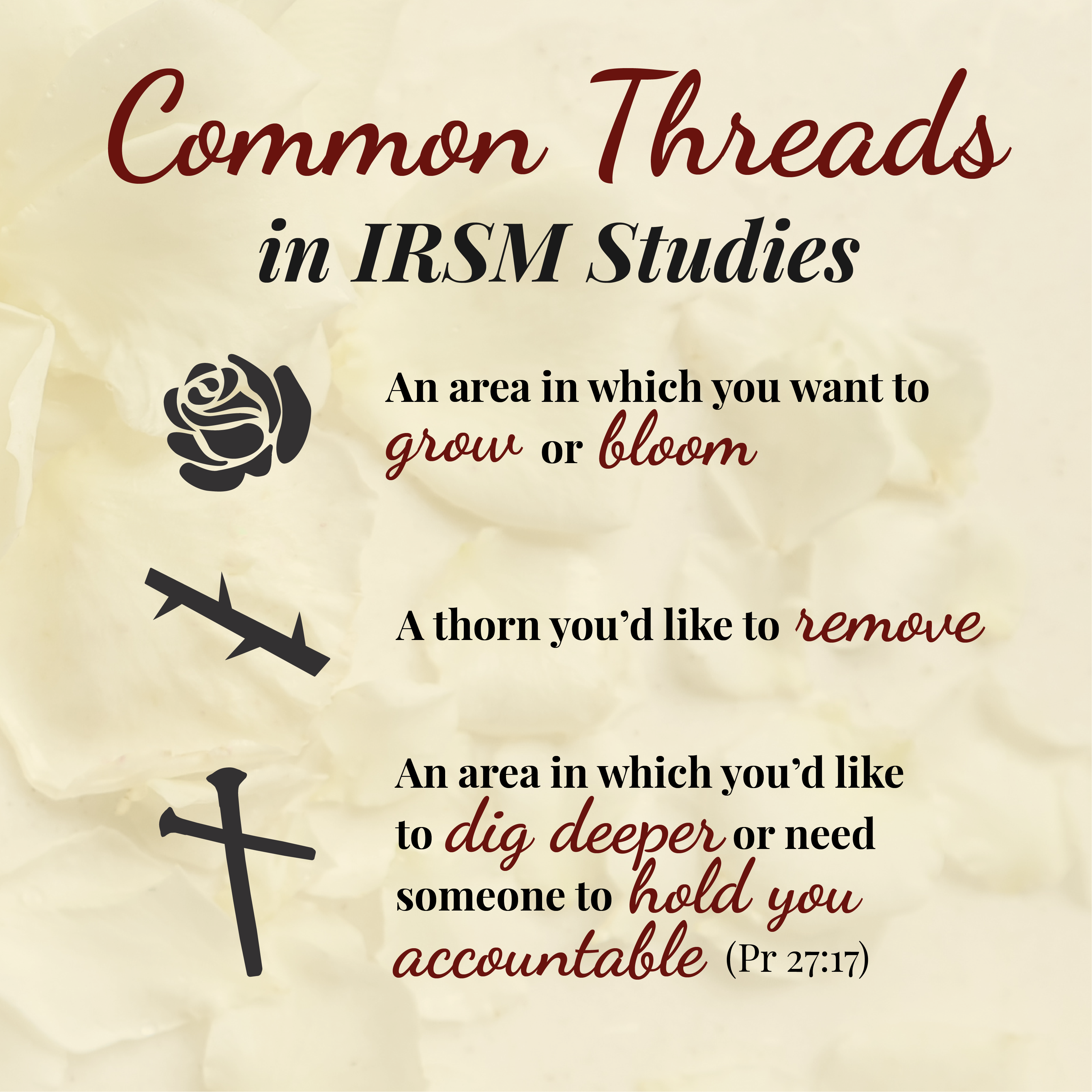 In the context of small groups or trios of women, we have an opportunity to participate in authentic, genuine relationships that can deepen our relationships with God and one another. Iron Rose Sister Ministries prays that we can equip you in those relationships, especially in your local churches and small groups. And one of the ways we do that is represented by the Common Threads— the three elements of the ministry logo. They are a way of making any Bible lesson very personal and practical: the sermon on Sunday mornings, your personal Bible reading, or your favorite chapter in an Iron Rose Sister Ministries Bible study book.
The Rose in The Common Threads
The bloom of the rose reminds us that we are all beautiful and unique roses in God’s Garden. It represents the areas in our spiritual lives in which we long to bloom or flourish.“…making it bud and flourish… so is my word that goes out from my mouth…” (Isa 55:10-11).
The Thorn in the Common Threads
The stem represents the thorns we identify and want to remove. They may be thorns like Paul’s (2Co 12:7-10) that torment us, or they may be sin struggles that hinder our growth.“…a thorn in my flesh to torment me… throw off the sin that so easily entangles…” (2Co 12:7-10; Heb 12:1)
The Iron in the Common Threads
Iron Rose Sisters, as shown in the form of the cross, lovingly serve as iron sharpening iron, as God transforms us into the image of Christ, and as we deepen our relationships with God and one another.“As iron sharpens iron, so one person sharpens another.” (Pr 27:17)
-
Committed to Prayer
 Written by Adriana Rocha, volunteer with Iron Rose Sister Ministries in Brazil
Do not be anxious about anything, but in every situation, by prayer and petition, with thanksgiving, present your requests to God. (Php. 4:6 NIV)
When I converted to Christ, I discovered that I possessed a weapon to use against my problems: prayer! In my process of learning to pray, I also realized how many things within me I needed to work on and improve. But, oftentimes with the wrong motives, I used prayer as a blindfold that kept me from seeing what was really happening and what I needed to do.
Over the past few years, during a very difficult period of my life, I have had my most intense experience with prayer. Although I did not intend for prayer to be a last resort, it was all that was left when all the other options were no longer available. But I was in a battle that I did not fight alone—I always had my relationship with God. In the moments that discomfort kept me from sharing with my brothers and sisters about the situation, I sought comfort in God.
This situation taught me that I need to pray, asking for help from God to see things as they truly are, discernment to know how I should proceed, and understanding of how and what to pray for. “In the same way, the Spirit helps us in our weakness. We do not know what we ought to pray for, but the Spirit himself intercedes for us through wordless groans” (Ro. 8:26). Once we understand what to do, we need to ask God for the strength to act.
One of the things that was very positive for me during this process was having a friend persevering in prayer with me. This dear, trusted sister spent hours on the phone with me. Our time together sharing what was happening and praying was very important to me. When I didn’t want to be patient and wanted to simply act without waiting for what God had prepared for me, this sister helped me to see the importance of God’s process of preparation. It is so precious to have someone praying with us: “For where two or three gather in my name, there am I with them” (Mt. 18:20).
Oftentimes during the break in church service, we would go into a room so that I could share how I was feeling, and we would pray together because I didn’t want anyone else to hear about the bad things that were happening. “Therefore confess your sins to each other and pray for each other so that you may be healed. The prayer of a righteous person is powerful and effective” (Jas. 5:16). Her encouragement for us to pray together made all the difference for me. She was also going through some difficult struggles and our friendship allowed us to pray for her problems as well.
But this time with her in communion and prayer did not replace my alone time with God. I continued praying “alone” too! I learned that even though God knows all things, rather than throw around random situations, my prayers should be specific. I prayed even in the moments that I didn’t know what to say to God, trying to hand over the situation to Him instead of spending my energy on something that I couldn’t do anything about.
I prayed even on the days that I had just enough strength to slide out of bed and get down on my knees and, not knowing what to say, just cry. “Then you will call on me and come and pray to me, and I will listen to you. You will seek me and find me when you seek me with all your heart” (Jer. 29:12-13). I feel that God has given me the strength and heart to keep me on my feet while facing this problem, sustaining me so that the new demands won’t shake me.
During the entire situation, one verse remained on my mind: “Have I not commanded you? Be strong and courageous. Do not be afraid; do not be discouraged, for the Lord your God will be with you wherever you go” (Jos. 1:9). If going through all of that was as difficult as it was, imagine going through it without God’s sustenance.
To conclude, I want to remind you that prayer frees us and brings us relief. It is a blessing to give up our worries to God. Even when we are unable to express them with words, God knows what we mean. “Devote yourselves to prayer, being watchful and thankful” (Col. 4:2). We cannot do what is not up to us. We need to hand our worries over to God. People often say: “All I can do is pray,” as if that were something small. But praying is the most important action of all. Instead, we should say, “I’m going to do the best thing I can do: pray!” Stop going around in circles on your own, come to the Creator, and follow His guidance.
What about you? Are you willing to be prepared by God to act after your prayer?
-
Compassion Implies Action
 Written by Kara Benson, volunteer with Iron Rose Sister Ministries in Alabama
Praise be to the God and Father of our Lord Jesus Christ, the Father of compassion and the God of all comfort, who comforts us in all our troubles, so that we can comfort those in any trouble with the comfort we ourselves have received from God. (2Co 1:3-4 NIV)
The Creator of the entire universe is described as the “Father of Compassion”; how beautiful and comforting! However, what exactly is compassion? In Hebrews 1:3a, we read that “the Son is the radiance of God’s glory and the exact representation of his being.” Therefore, we can examine the life of Jesus to understand the nature of compassion.
In the gospel of Matthew, Jesus travels through towns and villages, “teaching in their synagogues, preaching the good news of the kingdom, and healing every disease and sickness” (Mt 9:35). Jesus had compassion on the people He saw. He healed a leprous man (Mt 8:3), two blind men (Mt 20:29-33), sick members of a large crowd (Mt 14:14), and provided food for 4,000 hungry people (Mt 15:32). In the account of Jesus healing the two blind men, some versions say that Jesus was moved with compassion. When Jesus felt sympathy for others, He did something about it. From Jesus, we learn that compassion implies action.
As disciples of Christ, we are called to follow in His footsteps (Mk 8:34-35). We are to willingly lay aside our sin and self-absorption in the pursuit of Christ, following His example of being moved with compassion. Jesus declares, “Whoever serves me must follow me; and where I am, my servant also will be. My Father will honor the one who serves me” (Jn 12:26). According to the picture painted in scripture, compassion is clearly a central part of our commitment to serving Christ; it is even the basis for the separation of the sheep and goats on judgment day. Carefully consider this critical scene:
When the Son of Man comes in his glory, and all the angels with him, he will sit on his glorious throne. All the nations will be gathered before him, and he will separate the people one from another as a shepherd separates the sheep from the goats. He will put the sheep on his right and the goats on his left. Then the King will say to those on his right, “Come, you who are blessed by my Father; take your inheritance, the kingdom prepared for you since the creation of the world. For I was hungry and you gave me something to eat, I was thirsty and you gave me something to drink, I was a stranger and you invited me in, I needed clothes and you clothed me, I was sick and you looked after me, I was in prison and you came to visit me.” (Mt 25:31-36)
Subsequent verses explain that when we show compassion by fulfilling the needs of the least of Jesus’ followers, we are effectively serving Jesus himself. Let us contemplate the eternal value of exhibiting compassion.
The apostle Paul writes,Therefore, as God’s chosen people, holy and dearly loved, clothe yourselves with compassion, kindness, humility, gentleness, and patience. Bear with each other and forgive whatever grievances you may have against one another. Forgive as the Lord forgave you. And over all these virtues put on love, which binds them all together in perfect unity. (Col 3:12-14)
How can we show compassion by our actions?
- Volunteer at a pantry
- Drive someone to their doctor’s appointment
- Prepare food for someone who is sick, grieving, or a new mother
- Fervently pray for someone throughout the day
- Provide a listening ear for someone who needs comfort
- Help someone pack, unpack, or clean their house
- Humbly address unrepentant sin in a sister’s life that is endangering her soul
- Visit someone in the hospital, recovering at home, or lonely
- Forgive someone. Scripture frequently presents compassion and forgiveness together, indicating a connection between the two. As Ephesians 4:32 instructs, “Be kind and compassionate to one another, forgiving each other, just as in Christ God forgave you.”
A hard-working sister in our congregation is a good example of a compassionate Christian. She invited me to volunteer alongside her at a food pantry, woke up hours before sunrise to take me to an outpatient procedure, teaches children’s Bible classes, and regularly helps aging and disabled church members who need assistance. She can almost always be found doing something for someone. Her compassion reminds me of my favorite verse: “God is not unjust; he will not forget your work and the love you have shown him as you have helped his people and continue to help them” (Heb 6:10).
Compassion implies action. How can you show compassion today?
-
Confess to Rebuild
 Written by Vivian Arcila, volunteer with Iron Rose Sister Ministries in Canada
Listen to my prayer! Look down and see me praying night and day for your people Israel. I confess that we have sinned against you. Yes, even my own family and I have sinned! (Ne 1:6 NLT)
The book of Nehemiah not only sequentially details the biblical way to resolve conflicts and crises but also highlights the importance of confessing sin as an essential part of restoring our relationship with God.
It is interesting that when Nehemiah learns of the situation in Jerusalem and its captives, the first thing he mentions in his prayer is confession, not only of his personal sin but also of his family and his nation. He knew that the disobedience of the people of Israel had resulted in their destruction, and he felt responsible as well. Since ancient times, we have noticed that sin that is not corrected and is practiced deliberately can affect not only the person who commits it but also their family and even an entire nation.
Psalm 14:3 says, "But no, all have turned away; all have become corrupt. No one does good, not a single one!" As a God-fearing man, Nehemiah was aware that, although his works were pleasing to God, the human being is a sinner by nature. Nehemiah may have felt that he could have done more for his people before things got worse, but the truth is that confession is an essential part of our Christian lives.
Our walk in Christ begins with acknowledging that we have sinned before Him, repenting of our sins, and confessing Jesus as our Lord and Savior, which is confirmed with baptism and perseverance. Romans 10:9 says, "If you openly declare that Jesus is Lord and believe in your heart that God raised him from the dead, you will be saved." The doors of spiritual blessings begin to open with confession.
However, confession does not get stuck at the moment when we give our lives to Jesus. It should be a daily act to recognize Christ's lordship and discover our faults. In the face of every difficult situation, we must examine ourselves and confess our offenses to our Creator. In that moment of reflection, think about how much our personal sin has affected the family and, in some way, the community or society, and confess before God our participation in it, either directly or indirectly. It is not only sin to do evil to our fellow men, but also to fail to do good as James 4:17 says, "Remember, it is sin to know what you ought to do and then not do it."
Am I studying the Bible, praying, examining myself, and confessing my sins frequently? That helps me connect to God and cultivate a meek character that my family, church brothers and sisters, neighbors, drivers, people at the grocery store, and coworkers will notice. Not having good communion with God affects us personally because we lose peace, which is reflected in the treatment of our relatives and neighbors, causing a domino effect on the individual, family, church, society, and the whole world.
Let's try to make an effort daily in our relationship with God because it impacts, in one way or another, the life of our family and the lives of the people around us. Before we met Jesus, we were like a city with walls destroyed by sin. Now, we are being built on the rock that is Christ.
-
Confident Trust in All Seasons
Written by Kenva Barr, volunteer with Iron Rose Sister Ministries in Texas

But blessed is the one who trusts in the Lord, whose confidence is in him. They will be like a tree planted by the water that sends out its roots by the stream. It does not fear when heat comes; its leaves are always green. It has no worries in a year of drought and never fails to bear fruit.(Jer 17:7-8 NIV)
We are reminded to have confident trust in all seasons. Living the Christian life is beautiful. There are so many blessings that we receive daily, but there are also a lot of hard times we must endure. We can find ourselves feeling drained and empty at times. We endure pain and suffering, too. Even when we do our best, trials arise out of nowhere. These are our seasons of testing that can leave us feeling parched and weary. We may wonder, is God really listening to our prayers? If He cares for me, why do I feel so alone, and why do I have to go through this? Our scripture is a reminder to place our faith in God. The Greek word for faith also means to believe, and to trust… which is hard to do in times of “drought.” It is hard, but not impossible.
A confident trust in God leads us to do His will, despite what life throws at us. It is what drives us to praise even when our prayers may not be answered the way that we had hoped.
How can we have confident trust in all seasons? One way is to remember that Jesus warned us that the world would hate us, and the apostle Peter warned us to expect trials. Having a mindset that allows us to remember that “this is only for a season, and seasons always change” will help. Along the way, remember to keep praying and praising God. The Bible tells us that God will draw nigh to us if we draw nigh to Him, and we need His strength.
The evil one wants us to feel weakened and give up. He wants us to dismiss our faith so he can defeat us. He will remind you of your past sins to trap you with guilt, but you are already forgiven! He will put any obstacle in our way to stop us – even those we love – but we have God’s help. If you stumble, forgive yourself and pick yourself up; you have God’s grace. Remember, the enemy was already defeated at the cross.
Endurance is so important. Don’t allow your feelings to rule your actions. Keeping our focus on spiritual matters, especially when things go wrong, strengthens our faith. This is what it means to be rooted: you are unmovable. Keep following Jesus! Keep serving and loving others, and don’t neglect Bible study or worship. When possible, spend time with others of the faith to be strengthened. Share your struggles and how you have overcome them, too.
You never know who will benefit. Remember to ask for prayers when you feel overwhelmed, and talk to a trusted Christian who has gone through that struggle and can give you wise counsel. When I lack confident trust in God, and the scorching heat of fear and doubt try to burn me, I meditate on God’s promises for reassurance:
- God will never leave me nor forsake me (Heb 13:5,6; Dt 31:6; Isa 41:10).
- I can be content in every situation; Jesus is my peace (Jn 14:27; Eph 2:14).
- In my weakness, God lends me His strength (2 Co 12:9).
- God will meet all my needs (Php 4:19).
- God gave me a Spirit of power, love, and discipline (2Ti 1:7).
- If I put Him first, everything else will eventually fall into place (Mt 6:33; 2Co 5:9; Ecc 12:13).
- Everything will work out for the best because I love God and do His will (Ro 8:28).
- I can cast all my anxiety on God; He cares for me (Php 4:6,7; 1Pe 5:7).
- God will keep me; I don’t need to be anxious (Rev 3:10; Mt 6:25-34).
- God will fight for me (Jos 1:9).
Focusing on God’s promises helps anchor us in our faith. In any season, through any trial, we can confidently trust that God is in charge and that God has a plan for us (Jer 29:11).
What other promises of God can you think of, and how do these give you confident trust in Him?
-
Connected to the Vine: The Fruit of Resurrection
Written by Abigail Becerra, volunteer with Iron Rose Sister Ministries in Peru

With great power the apostles continued to testify to the resurrection of the Lord Jesus. And God’s grace was so powerfully at work in them all.(Ac 4:33 NIV)
We were therefore buried with him through baptism into death in order that, just as Christ was raised from the dead through the glory of the Father, we too may live a new life. For if we have been united with him in a death like his, we will certainly also be united with him in a resurrection like his. (Ro 6:4-5)
When I think of the resurrection, many times my mind goes to a special celebration, to a specific Sunday of the year. But the resurrection is not just a date... it is a source, it is the root that sustains all true fruit in our lives. If I am connected to the Vine, then the fruit that should begin to be seen in my life has a very clear explanation: the risen Christ lives in me, and because He lives, I no longer have to continue living the same as before. I don't have to stay in the same struggles, in the same habits, or in the same way of thinking. Jesus' resurrection means that there is new life available to us today, not just a future hope.
In Acts 4:33, we see something very beautiful. The apostles bore witness "with great power" to the Lord Jesus' resurrection. And if you think about it, it wasn't simply a message they were just repeating from memory, but a truth that had completely changed their lives. They weren't talking about an idea or a pretty theory. They were talking about someone who really lives. They had seen the risen Lord, and so their message had power. It wasn't just information; it was a life transformed, bearing witness to a Savior who is alive. And the result was clear: abundant grace was upon them all.
This confronts me a lot because when I really understand that Jesus conquered death, something in my life is supposed to look different. The resurrection is not just a truth I believe; it is a reality that begins to be reflected in how I am living. Grace should be seen in the way I speak, grace in the way I treat others, and grace even when circumstances are not easy. Because if Christ lives in me, then, once again, His life also begins to be noticed in my everyday life. So, the fruit of the resurrection is not just a spiritual emotion, but visible evidence.
Romans 6 should also touch us. This passage says that we were buried with Him and that we can now walk in newness of life. It is not only that Jesus came out of the tomb; it also means that I don't have to live in my old life anymore. So, in Christ, there is a new life, and that life begins immediately. That changes everything; it means that my past does not define me. It means that sin does not have the last word, that guilt has no permanent authority over my heart. Because He is risen, I can begin to walk differently. Walking in a new life involves a daily decision; it is not something automatic or simple. It is remembering every day who I am in Christ, it is choosing to respond patiently when I previously reacted with anger, to trust when I previously doubted, and to serve when I previously thought only of myself. That is the fruit of the resurrection: a real transformation.
One thing I really like about Acts 4 is that the fruit wasn't just individual; grace was over everyone. So, when a woman lives connected to the Vine, her life inevitably impacts others; their faith is strengthened, their hope is contagious, and their witness is encouraging. The resurrection also produces courage. The apostles preached even with threats around. Why? Because when you know that death has already been defeated, fear loses strength.
Sometimes I, Abbi, want fruit without the necessary process. I want quick changes, I want to see immediate results, but Romans 6 also tells us about being planted together with Him. Planting involves depth, roots, and time. This fruit does not appear overnight, but it does come when we abide in Him.
In conclusion:
- Being connected to the Vine does not mean there are no struggles; it means that life constantly flows from Christ to me.
- The resurrection is not just a doctrine that I believe—it is a reality that I must live by.
- And if Christ truly lives in me, it should be evident in some way.
In what area of your life do you need to remember today that Christ is resurrected in order to begin to walk in that new life that He has already given you?
-
Discipleship is a Requirement
 Written by Marisa Signoretti, volunteer with Iron Rose Sister Ministries in Ponta Grossa, Paraná, Brazil
Discipleship is considered a fundamental requirement for the transformation of the Christian woman, acting as an ongoing process that molds character, mind, and heart into the likeness of Christ. It is not merely a teaching method, but an intentional relationship and a daily journey of learning and imitation, essential for a complete change.
One of the greatest and most vital areas of women's ministry in the New Testament was discipleship. In the "Great Commission," Jesus Christ commanded His disciples to make disciples of others (Mt 28:19-20). Go and transform lives!
This process involved two principles, illustrated in the life of Jesus and His apostles: association and instruction (walking together and paying attention to what is taught).
To begin, a disciple associated or interacted with a person in a personal way. Jesus, for example, chose His disciples so that they could “be with him” (Mk 3:14 NIV), and be transformed into saviors of souls.
The apostle Paul also recognized that discipleship occurred in the context of intimate relationships or in the "sharing" of life (1Th 1:7-8). A transformed life is contagious.
The second aspect of discipleship was instruction. Disciples were to be taught to be obedient (Mt 28:20), encouraging people to learn more about Christ and His teachings so that they could be firmly rooted, built up in Him, and established in the faith (Col 2:6-7).
Paul instructed spiritually mature women to serve as mentors to younger women (Tit 2:3-5). Through discipleship with other women and bringing them to maturity in Christ, New Testament women glorified God and were fully involved in the ministry of God's Kingdom (the church).
Key aspects of discipleship as a requirement for transformation:
- Inner and character transformation: true discipleship seeks to align a person's character with God's character. This involves an inner transformation that alters values, virtues, and behaviors, promoting continuous growth in the image of Christ.
- The process of imitation: the essence of discipleship, from a Christian perspective, is the art of imitating Christ, with the help of examples. It is a calling to be molded, not just transformed.
- The cost of transformation: following Christ and going through the discipleship process involves renouncing and submitting one's own will to God's will, making the process a true test of commitment.
In short, discipleship is the vehicle through which transformation happens in the life of those who wish to go further – being transformed in order to then transform others.
Becoming a follower of Jesus is a commitment that requires a choice.
Jesus went straight to the heart of this commitment: His disciples were to deny their own desires in order to follow him. Commitment demands action; it cannot be separated from responsibility.
Are you committed to this type of transformation?

See more photos on our Photo Gallery page.
(c) Iron Rose Sister Ministries. Site setup by Perfect Fit Web Design; Flag icons by Free Flag Icons